
引入

需求

给定一个数组,有以下两个操作要实现

  1. query:能够计算前i个数的和;查询区间和
  2. update:支持单点更新

方案1:暴力法

  • query:用for循环求解,时间复杂度O(N)
  • update:直接赋值,时间复杂度O(1)

方案2:前缀和数组

  • query:用额外的空间存储,时间复杂度O(1)
  • update:赋值后,需要重新计算前缀和数组,时间复杂度O(N)

折中方案

  • Binary Indexed TreeSegment Tree

  • 查找和修改时间复杂度均为O(logN)

  • Binary Indexed Tree:更少的空间,更易实现

  • Segment Tree:更大的使用范围

  • The BIT is specifically used for Dynamic - Cumulative stuffs, whereas the Segment tree is more general and can be used in all those situations where, the divide and conquer paradigm can be applied over queried interval.
  • All the jobs doable by BIT can essentially be done by segment tree but not vice-versa
  • 参考2:评论区

定义及实现

原理

  • 任意整数可以表示用二进制的位组合表示

Each integer can be represented as a sum of powers of two. In the same way, a cumulative frequency can be represented as a sum of sets of subfrequencies

  • 假设某一个index的二进制表示形式为01100,index为BIT数组中的下标i,那么index位置的值表示记录原数组哪些范围的值呢?
    • 最后一个1拆开的第一个数开始01001(9)~它自己(12)
    • 因此重点是找到最后一个1的位置,利用lowbit函数进行快速查找
  • 注:除原数组外,下标表示从1开始

lowbit函数

  • lowbit(i):代表i这个数字,二进制表示的最后一位1的位权(最低为为1)

  • 例如(()内数字代表二进制,反之为10进制)

    1
    2
    3
    4
    5
    十进制			二进制	   只保留最低位1
    lowbit(8) => (1000) => (1000) => 8
    lowbit(6) => (0110) => (0010) => 2
    lowbit(12)=> (1100) => (0100) => 4
    lowbit(7) => (0111) => (0001) => 1
  • lowbit实现

    1. x & (-x)
    2. x & (~x + 1)

改进前缀和

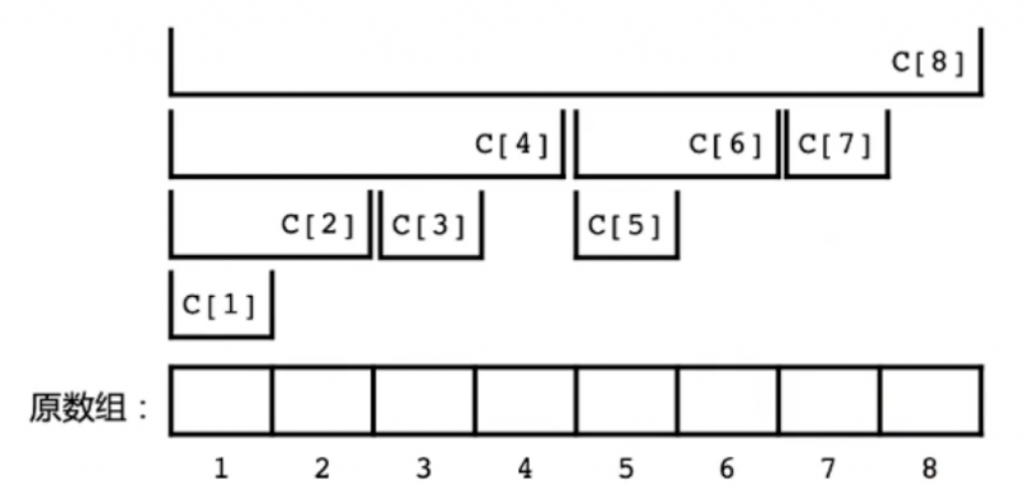
  • C[i]: 代表原数组中a第i位 的前lowbit(i)项 之和

  • 例如

    1
    2
    3
    4
    # lowbit(10) = 2,所以是从10开始(含),一共两项
    lowbit(10) = 2, C[10] = a[10] + a[9]
    # lowbit(12) = 4,所以是从12开始(含),一共四项
    lowbit(12) = 4, C[12] = a[12] + a[11] + a[10] + a[9]
img

query:前缀和查询

  • S[i] = S[i – lowbit(i)] + C[i]

  • 例如

    1
    2
    3
    S[7] = s[7 - lowbit(7)] + c[7] = S[6] + C[7] = S[4] + C[6] + C[7] = C[4] + C[6] + C[7]

    S[12] = s[12 - lowbit(12)] + c[12] = S[8] + C[12] = C[8] + C[12]

update:单点更新

  • 假设修改a[j],那么显然需要更新c[j],然后需要修改包含c[j]的区间,即c[i + lowbit(i)]

一维BIT

1
2
3
4
5
6
7
8
9
10
11
12
13
14
15
16
17
18
19
20
21
22
23
24
25
26
27
28
29
30
31
32
33
34
35
36
37
38
39
40
41
42
43
44
45
46
47
48
49
50
51
52
53
54
55
56
57
58
59
60
61
62
63
64
65
66
67
68
69
70
71
72
73
74
75
76
77
78
79
80
81
82
#include <iostream>
#include <vector>

using namespace std;

#define lowbit(x) (x & (-x))

class FenwickTree {
private:
int n; // 下标上限
vector<int> c; // 树状数组

public :
// 注意这里是n + 1
FenwickTree(int size) : n(size), c(n + 1) {}

// 对原数组进行单点增加 第i位的值增加x
void add(int i, int x) {
while (i <= n) c[i] += x, i += lowbit(i); // 向上更新
}

// 查询原数组 ind位置的值
int at(int ind) {
return query(ind) - query(ind - 1);
}

// 查询原数组 ind位置前缀和
int query(int ind) {
int sum = 0;
while (ind) sum += c[ind], ind -= lowbit(ind);
return sum;
}

// 查询原数组 [left, right]区间和
int queryRange(int left, int right) {
return query(right) - query(left - 1);
}

// 以下非关键内容,仅为测试用
// 测试输出
void output() {
int len = 0;
for (int i = 1; i <= n; i++) {
len += printf("%5d", i); // 打印坐标位
}
printf("\n");
for (int i = 0; i < len + 6; i++) {
printf("=");
}
printf("\n");
for (int i = 1; i <= n; i++) {
printf("%5d", c[i]); // 打印树状数组
}
printf("\n");
for (int i = 1; i <= n; i++) {
printf("%5d", query(i) - query(i - 1)); // 打印原数组
}
printf("\n\n\n");
}
};

int main() {
int n;
cin >> n;
FenwickTree tree(n);
for (int i = 1, a; i <= n; i++) {
cin >> a;
tree.add(i, a);
}
tree.output();
int ind, val;
while (cin >> ind >> val) {
cout << "change " << ind << " to " << val << endl;
// add函数是单点增加,所以需要求变化量
tree.add(ind, val - tree.at(ind)); // 将原数组ind位置的值 改为val
tree.output();
cout << "range sum 1-3: " << tree.queryRange(1, 3) << endl;
cout << "range sum 2-3: " << tree.queryRange(2, 3) << endl;
cout << "range sum 2-4: " << tree.queryRange(2, 4) << endl;
}
return 0;
}

二维BIT

1
2
3
4
5
6
7
8
9
10
11
12
13
14
15
16
17
18
19
20
21
22
23
24
25
26
27
28
29
30
31
32
33
34
35
36
37
38
39
40
41
42
43
44
45
46
47
48
49
50
51
52
53
54
55
56
57
58
59
60
61
62
63
64
65
66
67
68
69
70
71
72
73
74
75
76
77
78
79
80
81
82
83
84
85
86
87
88
89
90
91
92
93
94
95
96
97
98
99
100
101
102
103
104
#include <iostream>
#include <vector>

using namespace std;

#define lowbit(x) (x & (-x))

class FenwickTree2 {
private:
int n; // 行下标上限
int m; // 列下标上限
vector<vector<int>> c; // 树状数组
vector<vector<int>> a; // 原始数组

public :
// 注意这里是n + 1
FenwickTree2(int n_, int m_) : n(n_), m(m_), c(n + 1, vector<int>(m + 1)), a(n, vector<int>(m)) {}

// 对原数组进行单点增加 第i位的值增加x
void add(int i, int j, int x) {
a[i - 1][j - 1] += x;
for (int row = i; row <= n; row += lowbit(row)) {
for (int col = j; col <= m; col += lowbit(col)) {
c[row][col] += x;
}
}
}

// 查询原数组 ind位置的值
int at(int ind, int jnd) {
return query(ind, jnd) - query(ind - 1, jnd - 1);
}

// 查询原数组 ind位置前缀和
int query(int ind, int jnd) {
int sum = 0;
for (int row = ind; row > 0; row -= lowbit(row)) {
for (int col = jnd; col > 0; col -= lowbit(col)) {
sum += c[row][col];
}
}
return sum;
}

// 查询原数组 从[row1, col1]到[row2, col2]区间和
int queryRange(int row1, int col1, int row2, int col2) {
return query(row2, col2) - query(row1 - 1, col2) - query(row2 - 1, col1) + query(row1 - 1, col1 - 1);
}

// 以下非关键内容,仅为测试用
// 测试输出
void output() {
int len = 0;
for (int i = 1; i <= n; i++) {
len += printf("%5d", i); // 打印坐标位
}
printf("\n");
for (int i = 0; i < len + 6; i++) {
printf("=");
}
printf("\n");
for (int i = 1; i <= n; i++) {
for (int j = 1; j <= m; j++) {
printf("%5d", c[i][j]); // 打印树状数组
}
printf("\n");
}
printf("\n");
for (int i = 1; i <= n; i++) {
for (int j = 1; j <= m; j++) {
printf("%5d", a[i - 1][j - 1]); // 打印原数组
}
printf("\n");
}
printf("\n\n\n");
}
};

int main() {
int n, m;
cin >> n >> m;
FenwickTree2 tree(n, m);
for (int i = 1, a; i <= n; i++) {
for (int j = 1; j <= m; j++) {
cin >> a;
tree.add(i, j, a);
}
}
tree.output();
int ind, jnd, val;
while (cin >> ind >> jnd >> val) {
if (ind <= 0 || jnd <= 0) break;
cout << "change " << ind << ", " << jnd << " to " << val << endl;
// add函数是单点增加,所以需要求变化量
tree.add(ind, jnd, val - tree.at(ind, jnd)); // 将原数组ind位置的值 改为val
tree.output();
}
int row, col;
while (cin >> row >> col) {
if (row <= 0 || col <= 0) break;
cout << "query [1, 1] => ["<< row << "," << col << "] " << tree.query(row, col) << endl;
}
return 0;
}

参考

  1. Binary Indexed Tree or Fenwick Tree
  2. Binary Indexed Tree or Fenwick Tree
  3. BINARY INDEXED TREES
  4. 前缀和/树状数组
  5. index Tree
  6. IndexTree
  7. IndexTree以及应用